🇬🇧 engl transl
Anfrage an Baumkommunikatoren: Gießsäcke im Praxistest
Wie findet der Baum den Gießsack eigentlich? Hilfreich oder unerwünscht?
Logik: Es muss etwas extra produziert werden, um einem Baum Wasser zu geben und ihm zu helfen. Es werden PE und PVC als Material dafür verwendet – also Plastik- und PFAS-Problematik. Sollten PFAS bei Gießsäcken in Zukunft möglicherweise verboten werden, so war es eine kurzfristige Idee, oder es müsste neues Material dafür erfunden werden.
Die Wurzeln des Baumes wachsen wie die Krone. Der Sack wässert jedoch nur den Stammbereich. Beobachtungs- und Erfahrungswert: Befüllte Gießsäcke sind selten zu finden; sie werden oft als Mülleimer missbraucht. Zudem hängen sie den kompletten Winter um den Baum herum, wodurch keine Luft an den unteren Stammbereich gelangt.
Bei der Recherche nach „Kritik Gießsack“ oder „Wie sinnvoll ist ein solcher?“ zeigen 99 Prozent der Ergebnisse positiv werbende Webseiten. Ich fand jedoch schließlich doch einen fachlichen Beitrag gegen den Einsatz:
Aus einem Fachbeitrag von Norbert Benning (Dendrologe):
„Gießsäcke an Jungbäumen – gut gemeint, fachlich oft problematisch. Ich komme gerade von einem Bauhoftermin. Die Leitung hatte mich bewusst dazugeholt, um den geplanten Einsatz von Gießsäcken fachlich einzuordnen. Meine Empfehlung war eindeutig: davon absehen. Aus dendrologischer Sicht sprechen mehrere Punkte dagegen:
- Fehlgeleitete Wurzelentwicklung: Wasser wird direkt am Stamm abgegeben. Das fördert keine flächige Durchwurzelung, sondern begünstigt eine Konzentration im stammnahen Bereich – genau dort, wo wir sie nicht brauchen.
- Erhöhtes Risiko für Stammfäule: Dauerhafte Feuchtigkeit am Stammfuß schafft ideale Bedingungen für holzzersetzende Pilze. Besonders bei jungen Bäumen ein unnötiges Risiko.
- Hitzestau und Mikroklima: Unter dem Sack entsteht ein eigenes Mikroklima. Wärme und Feuchte wirken zusammen – das stresst das Gewebe zusätzlich.
- Materialproblem Kunststoff: Wir bringen bewusst Plastik in sensible Standorte ein, oft über Jahre hinweg. Das steht im Widerspruch zu jeder nachhaltigen Pflanzstrategie.
Der entscheidende Punkt: Ein Jungbaum braucht kein punktuelles ‚Versorgen am Stamm‘, sondern eine gleichmäßige, flächige Wassergabe im Wurzelraum. Genau das leisten Gießsäcke nicht. Ich verstehe, warum sie eingesetzt werden – sie wirken praktisch und effizient. Aber genau da liegt das Problem: Sie lösen ein organisatorisches Thema, nicht das biologische.
Eine einfache und kostengünstige Alternative ist die klassische Gießmulde mit gezielter, flächiger Bewässerung. Ein sauber angelegter Gießrand sorgt dafür, dass das Wasser genau dort versickert, wo es gebraucht wird – im durchwurzelbaren Bodenraum, nicht am Stamm. In Kombination mit organischem Mulch lässt sich die Verdunstung zusätzlich reduzieren und die Bodenstruktur verbessern.
Funktional, nachhaltig – und fachlich deutlich näher am Bedarf des Baumes. Mein Fazit: Wenn wir Bäume wirklich etablieren wollen, müssen wir wieder stärker vom Baum aus denken – nicht vom Arbeitsablauf.“
Aufruf zum Mitmachen
Diesen letzten Satz leite ich an Menschen weiter, die Lust haben, einen Baum mit installiertem Gießsack zu fragen, wie dieser das findet. Dazu die Frage nach Wünschen und Ideen, wie diese ausreichend Wasser bekommen könnten. Und als Bonusfrage: „Wie geht es dir hier und was brauchst du am meisten?“
Auch hier frage ich erneut so: Schreibe die Antwort gerne anonym oder namentlich genannt und, wenn du magst, sende ein Bild des interviewten Baumes mit.
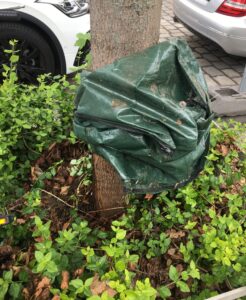
Galerie: Bäume mit Gießsack
Inquiry to Tree Communicators: Watering Bags put to the Test
How does the tree actually feel about the watering bag? Is it helpful or unwelcome?
Logic: Something extra has to be produced specifically to give a tree water and help it. PE and PVC are used as materials—bringing up the issues of plastic and PFAS. If PFAS were to be potentially banned for watering bags in the future, it would prove to be a short-term idea, or new materials would have to be invented for it.
A tree’s roots grow much like its crown. However, the bag only waters the area around the trunk. Observation and experience show that filled watering bags are rarely found; instead, they are often misused as trash cans. Furthermore, they hang around the tree all winter, preventing air from reaching the lower trunk area.
When researching „criticism of watering bags“ or „how useful they are,“ 99 percent of the websites found are positive promotional pages. However, I did eventually find a professional article against their use:
From a professional contribution by Norbert Benning (Dendrologist):
„Watering bags on young trees—well-intentioned, but often problematic from a professional perspective. I just came from a meeting with a municipal building yard. The management had specifically brought me in to provide a professional assessment of the planned use of watering bags. My recommendation was clear: refrain from using them. From a dendrological point of view, several points speak against them:
- Misdirected root development: Water is released directly at the trunk. This does not promote extensive rooting but rather encourages concentration in the area near the trunk—exactly where we don’t need it.
- Increased risk of trunk rot: Permanent moisture at the base of the trunk creates ideal conditions for wood-decaying fungi. This is an unnecessary risk, especially for young trees.
- Heat buildup and microclimate: A unique microclimate forms under the bag. Heat and moisture work together, putting additional stress on the tissue.
- Plastic material problem: We are consciously introducing plastic into sensitive locations, often for years. This contradicts any sustainable planting strategy.
The crucial point: A young tree does not need selective ‚care at the trunk,‘ but rather an even, extensive application of water in the root zone. That is exactly what watering bags do not provide. I understand why they are used—they seem practical and efficient. But that is precisely the problem: they solve an organizational issue, not a biological one.
A simple and cost-effective alternative is the classic watering basin with targeted, extensive irrigation. A properly created watering rim ensures that the water seeps in exactly where it is needed—in the rootable soil space, not at the trunk. In combination with organic mulch, evaporation can be further reduced and the soil structure improved.
Functional, sustainable—and professionally much closer to the needs of the tree. My conclusion: If we really want to establish trees, we must once again think more from the perspective of the tree—not the workflow.“
Call for Participation
I am passing this last sentence on to people who would like to ask a tree with an installed watering bag how it feels about it. Plus, the question about wishes and ideas on how they can get enough water. And as a bonus question: „How are you doing here and what do you need most?“
Once again, I ask: feel free to write the answer anonymously or include your name, and if you like, send a picture of the interviewed tree.
Gallery: Trees with watering bags